

Tried & True Garden Varieties

Giant Orange Marigolds.
In order to get you growing an amazing and fail-proof garden, I want to get you started with some of my tried and true varieties.
Since I’m a flower LOVER and flower grower this list will be flower heavy. BUT I also want you to have some of my favorite varieties for your veggie garden.
Over the years I’ve rubbed shoulders with vegetable farmers (quite literally - my husband managed a large vegetable CSA at the same time I started my flower farm) and tested different varieties myself.
Often just choosing the right varieties will set you up for success in the garden. And with SO many fun and beautiful varieties out there - how do you know what to choose?
By putting your ear to the ground and being committed to experimenting!
Wiser growers than I have told me to commit 20% of my farm to new varieties. I’m recommending this to you now too.
Don’t go overboard with new stuff - then you risk wasting too much valuable garden space to varieties that you’re not actually sure will produce well. Stick to tried and true varieties and dip your metaphorical toe into fun and exciting new ones each year.
So now on to my tried and true varieties that I know, you’ll love.
First, for the flower garden:
Ammobiom

Ammobium aka Winged Everlasting.
Centaurea - Classic Magic, Blue Boy OR Black Button
Calendula - Orange Button
Cosmos - any Double Click Variety
Cynoglossum - Chinese Forget-me-not OR Firmament
Dill - Bouquet
Ornamental Grass - Frosted Explosion
Marigold - Giant Orange
Nasturtium - Trailing
Nigella - Albion Black Pod
Poppy - Breadseed OR Shirley

Shirley Poppy.
Rudbeckia - Cherokee Sunset
Saponaria - Pink Beauty
Scabiosa - Black Knight
Snapdragon - Potomoc varieties OR Madame Butterfly varieties
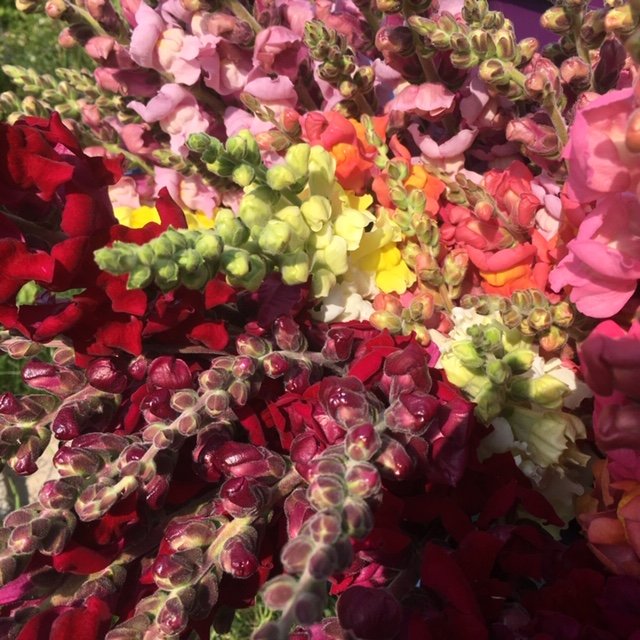
Bunches of Potomac Snapdragons.
Strawflowers - Copper Red OR Purple Red
Sunflowers - Procut varieties OR Sunrich varieties
Now for the veggie patch:
Beets - Touchstone Gold & Chiogga
Broccoli - Belstar

Belstar Broccoli just starting to grow crowns.
Carrot - Yaya
Cilantro - Calypso OR Cruiser
Cucumber - Diva OR Socrates
Kale - Red Russian OR Lacinato (also called Dinosaur or Black)

Red Russian Kale co-housed with Dahlias.
Peas - Sugar Ann OR Sugar Snap
Pumpkin - Cinnamon Girl
Spinach - Corvair
Tomato - Sun Gold
Zucchini - Dunja OR Blck Beauty
There you have it! This is by no means a comprehensive list but it’s meant to get you on the right track to a highly productive garden this season.
So now on to ordering seeds! GO HERE to read all about my favorite places to place your order.

My exact meditation & journaling practice
Over the years I’ve meditated and written in my journal. As a yoga teacher, I dipped my toe into meditation because that was part of the whole picture.
As I’ve traveled through life, I can’t say how many times the importance of meditation has come up for me: from business heroes and mentors, from athletes, from ALL sorts of people.
As an ex-yoga teacher, mom and entrepreneur, I now view meditation as the most important part of any self-care practice. Why? There’s lots of science behind it! I’m not a science writer BUT I’ll get to that later. And from experiencing my own .
Now let’s just clarify - I am not an expert. I am not a guru or even an accomplished meditator! I meditate 10 -15 minutes a day. Anyone can do that. I am not special!
So here are the steps to get you going:
1) Set a time each day that will work for you. Before bed (this is me), when you wake, during your lunch break.
2) Start with 1 minute. Or 2 minutes, if you’re really feeling mighty. Seriously! Do it.
3) Each day, add a minute until you’re up to your desired time limit.
4) After you meditate, pull out your journal and set your timer again. Journal for the same amount of time as you meditate.
5) Start your journal with 3 Good Things (just write down three good things from your day). This gets the pen moving quickly.
6) Next, show appreciation to those in your life, starting with yourself. I know there are lots of people to feel appreciation for, but just choose 3-4 per day, STARTING WITH YOURSELF.
Actually write out: “I appreciate myself for writing and publishing that blog post I’ve been thinking about” OR “I appreciate my husband for serving me a coffee on the couch this morning” (yes, this actually happens to me!).
7) Then just write. About feelings and observations. About epiphanies had during your day or during your meditation. About something you’re working through. About a new belief you want to have about yourself or someone else. Just to give you a few ideas.
8) Tools to make all this easier and more fun? There’s an app for that! Insight Timer. It’s amazing.
9) Insight Timer favorite meditations and content creators to follow:
Dr. Karolien Notebaert. Listen to her TEDx Talk (available on InsightTimer). So this is where I get back to the science part. Listen to this TED Talk to get the low down on what’s really happening in your brain! Then meditate to her “Body Scan to Let Go of Thoughts & Rise & Shine”.
Jack Kornfield. Listen to his “Breathing Meditation” and his “Loving Awareness: Mindfulness of Breath and What is Present”
Sarah Blondin. Listen to her “Loving and Listening to Yourself” and “Remembering Your Worth"
10) Don’t get lost in the app - find and follow a few people (like my favorites above) and stick with it.
11) And finally, anyone can meditate. Everyone’s mind wanders constantly. The practice is acknowledging the wandering and then redirecting it back to your body or your breath.
Ok, now you’re ready to go.
Comment below to let me know how your practice is going. And remember it’s called a practice because it IS a practice.
Some days suck.
Some days you feel amazing.
But I know from experience, this will take you places.
How to be in harmony with the dark
Harmony:
noun
An orderly or pleasing combination of elements in a whole.
A relationship in which various components exist together without destroying one another.
A relationship characterized by a lack of conflict or by agreement, as of opinion or interest.

Well, let’s be honest, it’s dark out.
It’s cold out too.
I was thankful to be on a zoom meeting with some parents from my son’s school recently as we labored together through a meeting.
The best part of the meeting? Folks were given the opportunity to share what’s been nurturing them through the darkness of winter.
I’m sharing this in hopes that you will love these ideas as much as I did. And be inspired to find a way to be harmonious with the dark as opposed to fighting it or dreading it, or complaining about it (as I have been guilty of).
Here’s what came up:
Reach out and call friends and family.
Cook and then have a dance party.
Go to bed early.
Check-in with friends.
Slow down.
Light candles have fires.
Practice the 4-7-8 breathing exercise (inhale for 4, hold for 7, exhale for 8). Oh man, do this ONCE and you’ll feel a difference.
Enjoy lots of coffee and cats.
Do some yoga. This woman specified doing yoga online with a dear friend who had moved away (which I thought was so lovely)
Go to the Russian Jack greenhouse aka Mann Leiser Greenhouse (or if you’re outside Anchorage, your local botanical garden greenhouse - most larger cities have them!)
Journal about feelings and observations (Here’s what I journal about every night: I start with 3 good things from the day, then give appreciation to people in my life - starting with myself. I literally write out: I appreciate myself for….. OR I appreciate my husband for…..
Get outside in the light.
Walk.
Run.
Get your nails done.
Find a place in the woods to sit and draw and write.
Meditate and write. I have a daily practice of a 10-15 minute meditation and 10-15 minutes of journalingl. It’s amazing and I’m sharing my exact practice HERE.
Until then, comment below to tell us how YOU get through the winter in harmony with the dark and cold.

Foam Free Floral Arch at Raven Glacier Lodge
Creating wedding florals in the most earth-friendly way is important to me. This summer I had the amazing opportunity to create two arches at the lovely Raven Glacier Lodge. In both arches, I used completely renewable materials (chicken wire and floral water tubes) to create the form in which to hold the flowers and foliage.
Here are the steps to creating a beautiful foam-free arch:

Create a cage. Cut chicken wire the length you need to hold your installation. Gather branches with leaves attached and lie the branches inside the chicken wire. Be sure to size your cage so it’s big enough to hold all your stems and water tubes but not too big so it’s hanging way far off your structure.
I recommend creating the cages at your studio and then adjusting them as needed once you get to your event space.

Wrap the chicken wire around the leafy branches and secure it with bits of wire. This is the foundation of your installation. The leaves will eventually dry, and if you are able to take the installation down after the event (or get your clients to return it), you can use this again and again.
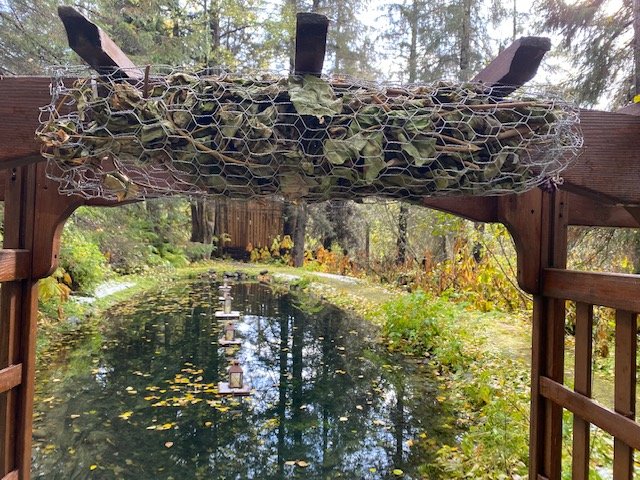
Attach your cage to your arch. I use zip ties for this. Cut your zip ties close once it is secured.

Begin designing with foliage. Use foliage to begin creating your shape.
Add in focal flowers. If these need a water source, be sure to cut stems and put them in water tubes.
Add supporting flowers and small bunches. Bunches of flowers can be made, stems cut, and wrapped in wet paper towels. These can then be wrapped in a bit of plastic and stuck in the chicken wire. If the bunches are bigger than the chicken wire holes, you can snip it to make a larger opening.

gently pull back on flowers once they are secured or gently shake the structure to make sure everything is solid!
Add additional foliage.
Add final flowers to round out your design.
Hide all mechanics with any final foliage and floral bits. Don’t neglect the back-side of your installation! Pop in some foliage or leftover supporting flowers to add a special touch.

Let the party begin!
I source all my flowers first from my urban flower farm, then from other Alaskan flower farmers and and finally from Mayesh Wholesale, who guarantees that everything I order from them is American Grown.
Local and seasonal flowers are more fresh, more beautiful and more earth-friendly!
Time to Plant Garlic
I’m a flower farmer but the one thing that I also let into my commercial garden is garlic. I LOVE garlic. It is easy and SO FUN to grow. Plus, once you’ve tried it fresh from your garden there is no going back to store-bought.

Freshly harvested garlic from the Turnstone Farm gardens.
Hopefully, after reading through these easy steps, you too will find BIG success with growing garlic.
But before we begin let’s do a brief garlic primer! So that we’re all on the same page, here are some basic garlic definitions.
A HEAD of garlic is the entire bundle that is made up of 2+ cloves.
A CLOVE is the individual piece of garlic that you would peel before cooking.
SOFTNECK garlic is a variety typically grown in more southern climates. Each head has many cloves and it is easily braided together into those quintessential garlic braids (maybe you’ve seen these at markets or in your grandma’s kitchen!?).
HARDNECK garlic is the best variety for Alaskan growing. It tends to produce fewer but larger cloves than softneck.

Garlic emerging in the early summer.
Ok, now on to the fun stuff. Here are 4 easy steps to successful garlic growing:
1) Prep your site: I like to start by clearing any old garden remnants and weeds, then adding any amendments like compost or soil nutrients that you may need. A comprehensive soil test will give you all the necessary info here. Loosen the soil with a broadfork or pitchfork.
2) Make your rows. I plant 4 rows to a 2.5ft wide bed. Dig a shallow trench about 3-4 inches deep with a flat-ended shovel.
3) Plant garlic. Place garlic cloves in the ground, about 3 inches deep with the pointy side pointing up. There is no need to peel the garlic clove but you do need to separate it from the garlic head (each head holds 2+ cloves).
4) Mulch. Mulching will protect the garlic cloves from any freeze-thaw action that occurs in the fall or spring.
NOTE, if you ordered seed garlic and it’s not here yet, don’t despair! MULCH your beds now to keep the soil insulated until you’re ready to plant.
Easy, right?! Now go do some planting. Your future self will thank you :)
In general, you will have the most success planting at any point from mid-September through mid-October. Although I have planted in early November in a pinch.

Lush garlic plants in the Turnstone Farm garden.
Interview with a Wedding Elopement Photographer

Morgan reads vows to Chris during their Alaskan elopement. Turnstone Farm was thrilled to create Morgan’s bridal bouquet. Big thanks to Tori Ware or Adventure Instead for this amazing photo.
This summer has been HOT for wedding elopements. As Alaskans in the wedding business, we are proud to be the home of one of the premier elopement destinations!
Recently my amazing and multi-talented summer employee say down with Tori Ware of Adventure Instead Elopements and recorded some great information on those looking to elope. Please enjoy!
What got you interested in elopement weddings and how long have you been doing them?
I have been doing elopement weddings for three years. Before this I had been doing big weddings for 5-7 years. In 2016 I did my own elopement and was inspired to share that same experience with other couples.
What is the process for planning an elopement? How do you specifically prepare?
Couples come to us knowing they want to do something unconventional.
We start off by helping them choose a location. They tell us what details are important to them and we scout and research potential locations for them to choose from. Usually, it involves adventuring in some way. Traditionally that looks like hiking to spectacular views.
Once a location is chosen we look into the best time of day for privacy and help them make a timeline for the day.
We give suggestions from attire to lodging, from our database and the couple uses our advising to complete the planning.
Take me through what the actual day of the wedding looks like.
In Morgan and Chris’ case (a Turnstone Farm wedding flower customer), we met at the trailhead at 5 am. They started off in their hiking attire.
They kept hiking until they found the spot that felt right. At that point, they each went to a spot to use as a “dressing room” separately from each other. They met back at the ceremony spot and faced back to back.
They hadn’t seen each other’s outfits up until that point. They turned around seeing each other in their wedding attire for the first time.
The ceremony included the exchange of vows and rings. I signed as the officiant.
Random hikers along the trail agreed to sign as their witnesses.
Do elopement weddings usually have a guest list, or is it just the couple and the wedding team?
I would say 60% of the weddings we do are just the couple and us. The other 40% invite some family and friends, with usually 20 people or less to keep it intimate… and not crowd the trails!
How do you source some of the basic wedding elements for the couple? ( i.e. flowers, food, makeup, hair, dress)
For locations we are familiar with we have a database of vendors that we recommend. For places relatively new to us we discover vendors through word of mouth in the photography/wedding community.
How would you describe your clients? Does it take a certain type of person to be able to have an elopement wedding?
Anyone can have an elopement. However, the clientele we attract are people that are most comfortable, most themselves, outdoors.
They like to do specific outdoor activities or are just travelers and explorers. They value experience and quality time over things.
Couples usually choose a place they have never been to before to experience a completely new adventure they associate with that special day.
Is there anything that your clients feel like they miss out on by having an elopement wedding compared to a traditional one?
My clients often say that it was an incredible experience and that they wouldn’t change a thing.
There is a misconception that you will miss out on family moments but there are plenty of creative ways to incorporate family and friends.
Some couples will invite a very small group which makes it more intimate than it would have been with a big production. Everyone comes in support of the couple. Instead of the couple spending a few minutes with each guest, as they would in a large wedding, they get to spend quality time for the whole day with those specially selected people.
What is your favorite part of elopement weddings?
When a couple finds a location for the very first time. They have never been to the spot.
Seeing their awe that this is really happening is my favorite part.
What is the toughest part of elopement weddings?
Mornings can be hard!
Summers have great lighting but it's hard to get up!
You need to be the kind of person that is okay with spontaneity. To go with the flow and be okay with a plan B.
What is the coolest location you’ve photographed/planned?
Before I would have said New Zealand. But right now I am obsessed with Alaska. I have been to Winterlake Lodge, Harding Icefield, and Knik Glacier. Alaska has all the best parts of New Zealand.
Do you have a dream destination you would like to photograph/plan?
Japan for my own personal bucket list. For a wedding, I would love to photograph in the Mediterranean. Switch it up from my usual mountainous landscapes.
What advice can you give couples who want to do an elopement wedding?
Think of your perfect date together and start with that as your base. What are you doing? What is the landscape?
And don’t stop there. Brainstorm the wildest possibilities then make it concrete.
Tradition often tells us how to do things and it just doesn’t have to be like that.

Morgan with a Turnstone Farm elopement bouquet. Thanks to Tori Ware of Adventure Instead Elopement for this gorgeous photograph.
Hatcher's Pass Elopement Flowers
I had the pleasure of creating wild and romantic florals for this adventurous couple who trekked up to Alaska for a picturesque elopement in Hatcher’s Pass.


Thank you to Echo Photography for these amazing photos.


What I love about creating wedding flowers is helping to transform a person to their most gorgeous version. I love creating a piece of art, from natural, ephemeral and inherently beautiful materials. I hope that each piece makes my customer feel like their highest most glamorous self on their wedding day.
Hatcher’s Pass is dear to my soul. Growing up in Eagle River and being in love with skiing, I spent many many days escaping to these mountains. My dearest friends shared precious times with me here.
I’ve run mountain ridges here. Climbed routes. Bagged peaks. Telemarked down powdery slopes. Played hooky from high school because the roads were too bad. Camped all seasons of the year here: sometimes in the car, in a hut, or under the stars. One night we slept on a tiny island on a tiny lake and counted over 50 shooting stars (none of us really slept). Berry picked. Celebrated my mom’s 70th birthday. Attended weddings. And so many more adventures!
This is such a special, wild and easy-to-access landscape that has something for every adventurous soul.

My House is a Mess
Recently my husband and I took the “Working Genius” quiz, formulated by Pat Lencioni. Which I highly recommend and sort of blew our minds.
It was of little surprise that we both do not thrive in the genius of “Tenacity”. Finishing tasks to the end brings neither of us any joy. Paying bills? Freaking boring. Making the kitchen sparkle? It’s fun to start, but seriously? Not interested.
I thrive on imagining and starting things and figuring out how to make things better.
He thrives on decision making and galvanizing (or bringing people together).
Unfortunately this means our house is a disaster area most of the time. I still struggle with feeling like a complete failure when I sit back and take in my messy house. Shouldn’t any remotely responsible adult be able to keep a house clean?
To make things worse a neighbor girl and her mom popped by one day and neighbor girl exclaimed: “why is your house so messy?” Major shame trigger.
I curtly (hopefully not TOO curtly) told her that I don’t clean my house on the weekend. Which is mostly true - It’s not that I don’t clean. It’s that the cleaning is never finished and I just give up. Or I just don’t do - especially on the weekends. Because really - why waste your time when you could be out playing or gardening or doing ANYTHING else?
So you’re probably wondering what this has to do with flowers?
Yeah, I was too until I heard someone say the reason they love flowers in their home is because it makes their house feel clean even when it’s not.
When I heard that I perked up! First off - there’s someone else without a clean home?!
And second - they’re SO RIGHT. Although I hadn’t put my finger on it - I too feel a sense of peace amidst the clutter, toys, crayons and laundry when a vase of flowers are in the room.
Isn’t that amazing?!
Do you feel this?
How do you feel when you have a vase of flowers in your home?
If you now know you NEED flowers CLICK HERE to learn all about our summer bouquet subscription!
May 20th Photo Garden Tour
It’s May 20th! Here’s what the Turnstone Farm flower field looks like today.

The garden is almost 75% planted! I brought on an employee for the summer (super excited!) and we’re making fast work of getting the flower babies in the ground. Here’s strawflower with a good view of my drip line irrigation system.

Dahlias are in! My designated dahlia bed at my 16th Ave plot is full. But not to worry - I’m opening a NEW plot in Rogers Park and will have space for many more :)
Note - if you’re planting dahlias, don’t forget to label the plant. I just cut leftover yogurt containers into strips, write the name with a grease pen (marker may wear off by the end of the season - I learned the hard way), and attach to the base.

Garlic - one of my all time favorite plants to grow! And I dedicated a precious full bed to it this year. If you haven’t grown this, you must. It’s something you plant in the fall, so don’t forget to mark your calendars to order seed garlic in late summer.

The tulips are SO CLOSE! I’m out there everyday checking the bloom status. Once they start blooming it happens fast! Just seeing these wavy and elegant leaves makes me so happy.

I put in 25 peonies last fall! Full disclosure - I am a peony NEWBIE. You can follow me along as I learn to grow this beauty. WIN #1 - they ALL survived the winter.
A handful of these were specialty and heirloom varieties from my farming friends at https://www.lyndakerfarms.com/. SO excited!!! Brides - be ready to be majorly wowed.
Big hugs to you mamas out there.
With Mother’s Day right around the corner, I’m taking a wander back through the years to when I became a mama. And thinking on the ways in which mama-ing and farming are intertwined and connected.
If you’re a mama, you know how everything changes once you have a little one join the family. Your time is no longer just yours, your body is no longer just yours, your dreams no longer just involve you! It’s an exciting, scary, and beautiful time.
The first night Llewyn was with us after an amazing morning birth he nursed continuously from 9 pm until 4 am. At one point I went back into our bedroom (I had made up a snuggle/nursing/area at the top of the stairs that had good lighting and felt cozy and airy at the same time), laid tiny Llewyn on the bed, and said to Jason, “I can’t do this.” He looked at me and said gently, “you have to, you're his mama”
Holy crap! Yes, he was right.
The next morning I relayed to my midwife the nursing marathon in hopes to get some sort of sympathy. None there either. She cheered and said, “Great!”.
Seriously?! Do you know what it’s like to nurse continuously for 7 hours?!

One of many sweet baby snuggles.
As I look back, that first night became good training, and a good metaphor, for parenting, for farming, and for life.
There are always things that come up that seem impossible, that you “just can’t do”. Until you do them. And then, you’re like - OK!
In farming, you’re considered a “beginning farmer” whether you have 0-10 years of farming experience. So after 9 years of farming, you are still a beginner! For some reason, I like this. It keeps you humble and makes mistakes and failures feel more acceptable. Because even though failures happen at every level of expertise, they are especially OK when you’re a beginner.
For some reason, I think of parenting in the same light - at 6 years in, I am still a beginner. Lighten up on yourself! Give yourself a break! You just started this journey! And it is not easy. Though at the same time it is beautiful and tender and joyful and fun.
So to all you mamas out there (beginner, intermediate, and expert): here’s to this incredible journey! It’s OK to make mistakes and to have failures. It’s OK to feel anything and everything about your mothering experience.
When Llewyn was born I was gifted with an incredible community of new mamas. We’d gather weekly in a small room in the back of a baby-mama retail store to talk about some deep stuff, all facilitated by a pre or post-partum professional. They weren’t scared to get us to talk real and open up. We spent two entire sessions telling our birth stories.
We talked about ALL the fears, the self-doubt, the partner frustrations, the loss of self, the nitty-gritty hard stuff. And what I learned the most was that all these feelings were NORMAL. Nothing was wrong with me or anyone else in the class. And by sharing we were helping everyone else feel normal too.
As I grow as a person in my business I’m learning this too - the hard feelings of business and life are normal! It’s not normal to feel good all the time. It’s OK to feel scared, to have self-doubt. As silly as this sounds, I didn’t know this! I thought everyone around me was just cruising through life happy and content and thoroughly self-confident. While I was the only one feeling ALL the feels.
So to wrap up this pre-Mother’s Day ramble, I just want you to know: you’re not alone. In your mama-ing, in your doubt, in your fears, in your dream-chasing, in your disappointments.
It’s awesome to celebrate the joy and love in life. LET’S CELEBRATE!
It’s also awesome to voice the hard stuff. Because it makes it feel less hard and makes us feel more connected. And who doesn’t want that?!

Me and a sleepy new-born Llewyn walking the road by our WIsconsin farm in 2015.
Field Notes: Week 15
April 12-16
We finally opened up the Airport Heights Elementary School greenhouse. After a couple of weeks delay due to below zero nighttime temps, we fired it up!
I am blessed to be able to use this space and am excited to say that I’m assisting in their annual plant sale this year.
Stay posted as I will be helping them sell Garden Kits this year - full of a collection of popular and simple to grow veggie, herb, and flower starts.

Me in the greenhouse after moving plants from my home seed starting set-up (lights and shelves). Look at those freaking dahlias!!!
It happens every year… I am officially behind on planting!
Here’s what I was SUPPOSED to plant this week:
Scabiosa: fire king & black knight
Coreopsis hybrida: Incredible! Tall Mix
Cynoglossum: Firmament OP
Dill: Bouquet
Gomphrena: QIS Orange & QIS carmine
Grass: Ruby Silk
Grass: Highlander
Kale: Elegance
Nasturtium: Trailing Mix & Phoenix & Purple Emperor
Marigold: Giant Orange
Poppy: shirley
Saponaria: pink beauty
Zinnia: queen lime orange & queen lime with blush & Zowie Yellow Flame
Statice: QIS apricot & Rosysed
Here’s what I actually did plant:
Ranunculus: ALL my saved corms. Happy to say I saved around 200 corms from 2020.
Anemone: ALL
Oh well - you know what I’ll be doing tonight! Catching up on planting.
Last but not least: the kids and I started a planter garden on the front porch. Each planter is filled with a different salad green: arugula, spinach, lettuce mix, swiss chard, and baby kale.
We sprinkle the seeds on top of the soil - pretty close as we want lots of small baby greens. Then press down gently and water in. Then we’ll keep the seeds lightly watered until they germinate.
I’m so excited every year to do this as I get to plant a good 2-3 weeks before I can really get in my garden beds. And by that time we’ll be harvesting salad every night!
Once the salad greens are done I’ll move a few dahlias and tomatoes into those planters. This, dear friends, is a great method if you’re tight on space!
Field Notes: Week 13
We celebrated my mom’s 70th birthday this past weekend! Along with another dump of snow and low temperatures, winter is persisting. Here’s what I seeded this week:
Amaranthus: coral fountain & Emerald tassels
Ammobium: winged everlasting
Bupleurum
Celosia: Chief Mix OP
Cerinthe: Kiwi Blue
Cosmos: double click snow puff & double click bicolor violet
Heliopsis (P): Burning Hearts
HIbiscus: Mahogany Splendor
Rudbeckia: prairie sun & Cherokee sunset
Ruby Silk
Eucalyptus: lemon bush
Broccoli: belstar & blue wind

Field Notes: Week 12
Here’s what I seeded this week:
Stock - Iron Rose, Iron Apricot and Iron Yellow (I only grow the Iron varieties nowadays)
Dusty Miller - New Look (I love this stuff but it’s finicky in the vase. We’ll see how much I actually use)
Ammi - Dara
Atriplex - Copper and Red
Frosted Explosion (an amazing ornamental grass)
Statice - Blue, White, Apricot, Rosyred (new color!!)
Artemesia - Sweet Annie
Tomatoes - Sungold (my absolute favorite), Edox, Sakura, White Cherry, Chocolate Pear
Dahlias - planted the remainder of my dahlia tubers to equal 150 plants. Have some tubers left over. But my house is full.
Just about ready to transplant plants from a couple of weeks ago!
Came home from a weekend in Talkeetna to find an entire tray of seedlings all dried out!! NOOOO! Luckily they perked right up.

Half my dahlias are up and under the lights!
Field Notes: Week 11
March 15-21
Here’s what I seeded this week:
Achillea-Cloth of Gold (40). Love this name. Also ordered Cassis, but there was a crop failure.
Asclepias-Wild Orange Type (20), Snowy Milkweed (20)
Gomphrena-QIS Orange (40)
Echinacea-Bravado (20), Green Twister (20)
Eryngium-White Glitter (40)
Solidago-Golden Baby (20).
Rudbeckia-Green Wizard (20), Cappuccino (20), Denver Daisy (20), Triloba (20)
A few dahlias are starting to sprout: Thomas Edison, Ben Huston, Cafe au Lait. So glad I’m not heating a greenhouse yet! It’s been cold (negative last night) and we got over a foot of snow in the last week.

Thomas Edison dahlia is the first to sprout! Once they sprout, put them under lights and start to water them regularly.
Field Notes: Week 10
March 8-14
I started my first round of seeds on March 9th. Everything this early goes into 3/4” soil blocks. Here’s a list of what I seeded with corresponding quantities:
Monarda-Panorama Red (40)
Oregano (40). 3-5 seeds per block
Sage (40)
Rosemary (40). Would have seeded thyme but realized I didn’t have thyme seeds. Ugh, something like this happens every year!
Eucalyptus-Lemon Bush (60). There was a seed shortage/failure of 3 other eucalyptus vareiteis so I am only able to grow Lemon Bush this year. Hope it’s awesome as I’m in love with eucalyptus.
Verbascum-Rosetta (20). NEW VARIETY. Trialing this!
Snapdragons-Potomac Cherry, Potomac Appleblossom, Potomac Ivory, Potomac Royal (40 each)
Gomphrena-QIS Carmine (10), Audray White (60). Looking forward to growing these again after a few years off.
Dahlias-a whole buch of varieties (75)
Aside from dahlias, all plants are on a heat mat and under a light. Dahlias are in either a gallon pot or a 4” pot depending on tuber size.


Seed starting set up on the left. I have one shelf with lights so far! On the right, seeds have germinated! Ones in front are looking a bit leggy: need to lower my lights.

5 of my Favorite Edibles!
Flowers are not just food for the soul! They can also be REAL food. In fact, my two kiddos DELIGHT in plucking a flower and munching.
I want to share 5 easy flowers that you can grow AND eat!
Flower petals can be used fresh or dried for garnish during the cold, dark winter months.
Aside from nasturtiums, which are completely edible (leaves and stems), be sure to eat only the petals of these flowers.
Calendula
Tangy and slightly bitter, you can add these petals to sweet or savory dishes.
An easy to grow and prolific bloomer. They also readily self-seed in the garden for years after your first planting.
Direct seed in the garden after last frost OR start indoors 4-5 weeks before last frost (which in my neighborhood is around May 15th).
Plant in the garden or in planters giving about 6-9” of space between each plant.
Bachelor Buttons
These flowers are delicate and whimsical and are always one of the first to bloom! They are mild and sweet.
Direct seed as soon as soil can be worked or start indoors 3-4 weeks before last frost.
Plant out about 6-9” apart in the garden or in planters. Be sure to stake as these grow tall and can easily topple in a wind storm.

Calendula comes in colors ranging from pale yellow to rich orange.

Bachelor Buttons are one of the first annual flowers to bloom in the garden.
Snapdragons
Snapdragons are a workhorse in my flower garden. They come in many colors, last a long time in the vase, are cold hardy AND you can eat them. They taste a bit bitter and floral :) Add a few as garnish to salads, deserts or drinks.
I would say these are for the intermediate grower. They can be tricky to germinate so plant a few seeds per cell or pot. Press the seed gently into soil but don’t cover as this seed needs light to germinate.
Start these early! I’m planting my first succession (a succession is simply anytime you seed a specific variety) the 3rd week in March. I’ll do two successions about 3-4 weeks apart.
Space about 6-12” apart in the garden. Be sure to pinch when plants are 4” high - this will give you a branching plant with lots of blooms!
Nasturtiums
These guys are the classic edible. They taste a bit spicy and both the flowers and the leaves look amazing on a salad.
Plant directly in a pot or in the ground 2 weeks before last frost OR start indoors 3-4 weeks before the last frost.
Cover seeds, as they require dark to germinate.
These look amazing anywhere in the garden, in planters or hanging pots. Plant about 3 plants per 10” pot or space 8-12” apart in the garden.

Nasturtiums: a bright and cheery addition to your salad.

Snapdragons come in tons of colors!
Sunflowers
Not only can you eat the seeds, you can eat the petals! They are bittersweet and will brighten up any salad or dessert.
One of the easiest flowers to grow. They do great in pots (but will be shorter and smaller), or in the garden. Folks tend to think these need to grow super tall! I personally love these to be more manageable for the vase so grow them closer together (6” apart).
Direct sow in the garden after last frost. You can also start indoors 2-3 weeks before planting outdoors. They grow fast, so don’t start too soon!
Two of my favorite varieties for the vase are ProCut Orange and ProCut Gold and Sonja. If you’re looking to grow seeds, go with Standfast from Fruition Seeds.

Sunflowers (edible) & zinnias (not edible) harvested off our old farm in WI.

Sunflowers on our old farm in WI.

Heirloom? Open-polinated? Organic? What does it mean!?
When shopping for seeds it’s helpful to have a little base knowledge otherwise the language can seem a little overwhelming.
I’m here to demystify a few terms that you may encounter when shopping for seeds.
Heirloom Seeds
These guys have been passed down through the ages and replanted, tended and harvested year after year after year. A seed that has been grown and passed down for 50 years is technically an heirloom.
Heirloom seeds often come with a rich history. They follow people as they move around the globe. They hold stories of those who have perpetuated them for years. If you choose to grow heirloom, you are ensuring that this rich part of civilization (seed saving and passing down) continues.
Open Pollinated Seed
This is a term meaning that seed will produce seed naturally. Pollination will occur just as nature intends by bird, bee, wind or by hand. As long as there are no other plants of the same species nearby, each open pollinated plant will produce seed that will grow another plant identical to the parent.
All heirloom seeds are open pollinated. But not all open pollinated seeds are heirlooms.
My favorite part of growing heirloom and open pollinated varieties is that it’s the ultimate do-it-yourself way to garden. And it also feels like you’re sticking it to The Man! There’s no patent on your plants. It’s yours for as long as you can care for and save your seeds year after year after year.
Hybrid Seeds
If you’re growing a hybrid seed it will usually have a little F1 on the label. Hybrid plants will not produce seeds that are true to type and they will have significantly decreased vigor. Which means no saving hybrid seeds! You must buy them again each year.
Hybrids are created by crossing different plant varieties to form new varieties in order to produce some sort of desired trait (better disease resistance, better shelf life, better taste, etc). But don’t worry, they’re save and have nothing to do with GMOs.
Here’s a cool thing too: hybrids can be stabilized over the years by growing and selecting for traits and perpetuating that variety. But for most of us, this is a bit over the top.
Organic Seeds
Organic seeds are always non-GMO and produced by growing the parent crop in accordance with the organic standards for certification.
You can have organic or non-organic heirlooms, organic or non-organic open pollinated and organic or non-organic hybrids. Whew!
GMO
So I just went straight to the non-GMO project website for this one:
“A GMO, or genetically modified organism, is a plant, animal, microorganism or other organism whose genetic makeup has been modified in a laboratory using genetic engineering or transgenic technology.
This creates combinations of plant, animal, bacterial and virus genes that do not occur in nature or through traditional crossbreeding methods.”
Fortunately none of my favorite seed resources have anything to do with GMOs. Unfortunately, GMOs can be harder to tease out when we’re in the grocery store.
Just remember: organic is always non-GMO.
Seed Resources
Baker Creek Heirloom Seeds - sells exclusively heirloom seed.
Seed Savers Exchange - sells exclusively heirloom seed in both organic and non-organic varieties.
Johnny’s Seeds - has some of everything: heirloom, open pollinated, organic and hybrid.
Fruition Seeds - all organic-heirloom or organic-open pollinated seeds.
High Mowing - all organic seeds in either hybrid, open pollinated or heirloom varieties. They have a fun variety pack for sale that’s called “Heirloom Vegetable Lovers Organic Seed Collection” for $19.25.
Thanks for reading! Feel free to leave your favorite seed sources in the comment section below :)

Best of 2020: My Favorite Varieties from the Veggie Garden
Corvair is a slow to bolt spinach variety that needs a place in every home garden.
In addition to growing flowers, I grow a big veggie garden in our backyard.
Every year our lawn gets smaller and our veggie garden gets bigger.
Here are some of my favorite veggies from the garden this year:
Tomato: Sun Gold. A sweet, early and prolific cherry tomato. The past two years I’ve been thinking: “maybe I should just grow all Sun Golds!” But I also like to have variety.
You will not be disappointed. I grow mine in an unheated hoop house. Next year I will trial these outdoors.
Kale: Red Russian. I’ve been growing Red Russian for six years. It is just my absolute favorite kale year after year.
It’s meaty and sweet in the fall. Plus you can grow it as a baby green by planting densely OR grow into a large plant for bunching. Once cut and massaged with dressing it makes THE BEST kale salad.
And get this folks, we still have kale in the garden now (it’s November as I write this)! We planted a HUGE bed of kale early in the summer. The leaves are frozen but you can go pick and they saute into an amazingly sweet and delicious side dish.
Carrot: Yaya. A yummy 5-6 inch sweet and tender carrot. Great for eating right out of the garden. With kids around, I just can’t keep carrots in the ground till the end of summer :)
Broccoli: Blue Wind and Belstar. I loved both of these varieties. Delicious and huge! Once the main head on Belstar is harvested it goes on to produce lots of side shoots. Blue Wind, not so much. It’s more of a one-and-done variety.
Cucumber: Socrates. A great cuke for Alaska. 52 days to maturity (once transplanted out). It’s seedless, sweet and tender. The kids (and myself) ate these like candy all summer long!
I’d like to try these outdoors next year to see how they perform. But in my unheated hoop house, they did amazing in pots. I trellis these straight up to the roof of the hoop house in order to squeeze in more plants.
Zucchini: Dunja. A classic, high-yielding zucchini that I grow every year! Don’t make the mistake and grow these too big. Although it’s fun to have big zucchini in the garden, they are the most succulent when picked at the proper stage (when fruits are 6-8 inches long).
Cilantro: Calypso. If you avoid growing cilantro because it bolts too fast, try this one! It is the slowest to bolt! Then when it does, you can cut the flowers to put in a vase (they smell heavenly) or wait till it forms seeds and use them as fresh coriander. Yum!
Spinach: Corvair. A delicious, juicy spinach. This is slow to bolt, so does well into the early summer.
And of course there are more!
If you need a suggestion for a certain variety, ask below in the comment section OR send me an email at turnstonefarm@gmail.com.
There’s nothing I love more than talking about gardening.

Best of 2020 - Part 2: My Absolute Favorite Flowers of 2020
Ben Huston is one of my absolute favorite dahlia varieties. It makes my heart go “boom” every time.
Every year I grow new varieties to test and then report back on what I absolutely loved. Since I also have a small growing space I have to ruthlessly cut anything that doesn’t preform well.
I’ve looked over what I grew in 2020 and am pleased to say the below flowers made my “Best of 2020” list.
Saponaria - Pink Beauty. A nice early bloomer to fill vases early in the summer. Harvest when the first buds are open. The remaining buds on the plant will slowly open in the vase which gives you a nice long lasting cut flower. Needs staking in the garden or wind and rain might topple it.

Saponaria is the pink airy flower with the green buds that is arranged horizontally.
Strawflowers - Copper Red, Purple Red, Vintage White. These are so magical! How can I pick just one?!
These are 3 that I LOVED. A long lasting, magical and whimsical cut flower. Blooms dry great but they need to be wired as stems become weak with drying. Best of all they are super easy to grow! So if you’re new to growing flowers, start with these.

Copper Red Strawflower
Eucalyptus - Silver Drop & Silver Dollar. I first tried these last year and fell in love. Adds texture and interest to any flower garden.
I am also pleased to say that they looked amazing in pots! Plus they are relatively frost hardy, so mine looked great through October.
Be sure to start these guys early under lights as they are slow to grow!
Statice - QIS Apricot. The designers who bought from me this year absolutely LOVED these. The color is one-of-a-kind. And the tiny whorls of blooms create a nice textural element. Plus they pretty much last forever once dried!
Scabiosa - Black Knight. Every year I grow these. And every year I LOVE them more.
Unfortunately germination can be spotty, so I didn’t have a lot of blooms this year. Planting way more next year. They are true magic.
Grass - Frosted Explosion. Oh wow! Such an ethereal addition to the garden. An airy-fairy grass that looks awesome in the vase and dries amazing.

Scabiosa - Black Knight
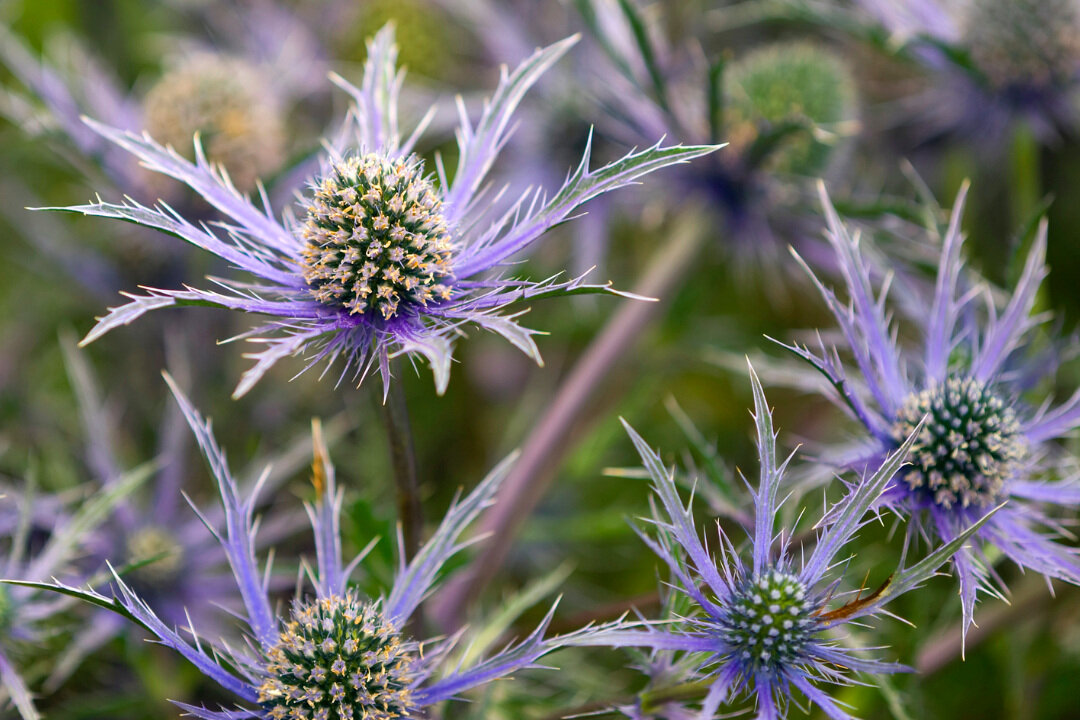
Eryngium - Blue Glitter.
Eryngium - Blue Glitter. This gets a 10+ for cool looks! It has attractive thistle-like blooms with a metallic shine. Eryngium is a hardy perennial with long, sturdy stems.
Does well in hot, sunny locations. But also tolerates a wide variety of conditions. Expect flowers during the second year of growth and in subsequent years (although mine bloomed the first year!). Great for bees, beneficial flies and wasps. Also known as plains eryngo and flat sea holly.
Excellent long lasting cut flower and dries well!

Ben Huston Dahlia in a bouquet.

Dream Catcher Dahlia.
Dahlias - Ben Huston. A juicy orange color on showy decorative petals. Just makes my heart pound every time I see this bloom.
Dahlias - Golden Sceptor. First year growing this dainty and cheerful beauty. True yellow flowers are only 2-3 inches. Such a happy-maker! Your garden will seriously sing with these little beauties.
Dahlias - Dream Catcher. This is a stunning cut flower. Perfect petals that meld pink to yellow to green on strong and upright stems.

Rebecca Lynn Dahlia
Dahlias - Rebecca Lynn. Here’s what I said about Rebecca Lynn last year:
“Rebecca Lynn Dahlia is not just pink, it’s power pink. It’s get-things-done pink. It’s an Elizabeth-Warren-suit-jacket pink. A “nevertheless-she-persists” pink. A woman-with-a-plan pink. Grow this dahlia and you’ll want to do things! Go places! And get er done!”
Looks amazing in the garden and in pots.
There it is friends!
My Best Flowers of 2020.
Now go grow some amazing flowers.

Best of 2020 - Part 1: My Favorite Podcasts
While it feels a little funny to write a title with both “2020” and “best of” it’s true that there was some real beauty that happened this year.
As an optimist in training it’s my duty to dig deep and find all the gems. I’m starting off here with my absolute favorite podcasts of 2020.
I spend HOURS during the summer doing manual labor (weeding, cutting, turning compost, making bouquets, delivery driving, etc) which means I have hours of time to think. But when I need a little entertainment, education or thought provocation, I turn to a good podcast :)
Here’s to hoping you might also find some valuable gems in the list below!
Personal Growth & Inspiration
Unlocking Us - Brene Brown. WOW. If you want some deep thinking and exposure to a lot of amazing books/authors, you gotta listen. Brene is an amazing social researcher and stunning interviewer. I pretty much write down the book of every author she interviews as a “must read”. Plus she has a two part series on “How to Apologize”… haha! (which is amazing).
Learning How to See - Brian McLaren, Jacqui Lewis, Richard Rohr. This podcast has a strong christian lean and while I don’t identify with any religion I love listening to these three explore how and why people see things the way they do. And can I say how helpful this has been for me during this turbulent time in our country?!
How to Save a Planet - Dr. Ayana Elizabeth Johnson, Alex Blumberg. Interesting and provoking discussion on climate change and what we can do. While it’s easy to go down the doomsday rabbit hole, these folks help keep it real and explore actual solutions while delving deep into questions like: are electric cars actually better for the earth?
Code Switch - Shereen Marisol Meraji, Gene Demby. Talk about race and current events. Since I live a very white-washed life I need to constantly be educating myself and listening to other voices that come from folks that have different experiences than me. I’ve heard some really interesting stuff on this podcast! And hopefully I’m a better person because of it.
Biz
The Gary Vee Audio Experience - Gary Vee. It’s always just an inspiration to listen to this guy. Wanting to start a business? Or a personal brand? Or just get pumped up about life? Go here.
The Profitable Mindset - Charlotte Smith. Charlotte is my go-to for anything related to farm and business. It’s rare to get really good info about managing a thriving farm business. And she has you covered. All the info is also pertinent to any sort of product based business.
Seth Godin’s Startup School - Seth Godin. So much good info on taking your idea and turning it into a business! This is a recording from an actual training he did with a bunch of business launchers.
Pure Comfort
This American Life - Ira Glass. I first listened to '“This American Life” almost 20 years ago. I was sitting in my tiny cabin in the woods on San Juan Island and was instantly mesmerized.
It was a story recorded by a woman who had cystic fibrosis. The entire episode was her recording daily life with this disease. I didn’t know radio could be like this! I’ve been an avid listener ever since. Ira Glass has come to be a voice of home for me.
Marketplace - Kai Ryssdal. My weekday is not complete without the voice of Kai Ryssdal speaking on our economy. No matter the turn of events, he makes economics fascinating and soothing at the same time.
Interesting Thought
Unfinished. The two series so far are “Deep South” and “Short Creek”. The first investigates one (of many) lynchings in hopes to find the ultimate culprit. Along the way you are reminded of (or educated on) the extent of racism in our country.
“Short Creek” looks closely at a fundamentalist Mormon community and the disturbing and complex relationships there. Neither of these is for the faint of heart. Fascinating, disturbing and chilling.
Nice White Parents - Chana Joffe-Walt. I sent my son off to kindergarten this year. Which of course, thanks to the pandemic, meant we made a space in the front room for a desk and his school work. But I seriously agonized about school choice. And still sort of am.
This podcast follows schools in New York City and highlights the real issues around what’s wrong with our schools. And according to the episode notes, “you have to look at what is arguably the most powerful force shaping them: white parents”.
Where Should We Begin - Esther Perel. Esther is a famous couples therapist who does a one time therapy session with folks for her podcast.
I heard her say that she started this podcast because she hopes people will see themselves in the people she works with in order to learn more about themselves and their relationships. And let me just say, I have.
There Goes the Neighborhood - WNYC. I never really thought gentrifying had anything to do with me so sort of shrugged it off (not proud of this). Seriously folks, gentrifying is complex, sad, and racist.
This podcast really opened my eyes to some of the struggles folks face in regards to housing, racism and the gentrifying of neighborhoods from New York to LA to Miami.
Whew! There it is. The official “Turnstone Farm’s Best Podcasts of 2020”. I hope you find a bit of value in some of these.
Do you have any to add to my list? Comment below to tell me what you’ve been listening to and loving!