

2019 Must Grows! 10 of my favorites from the garden that YOU must try
Each year I try to take copious notes on all my varieties.
At the end of the year I pour over these and decide on what varieties were rock stars and which varieties to cut in the year to come.
There are obvious choices and often tough choices to make as I plan my garden for next year.
Lucky for you, I’ve done all the hard work! Read on to find out what varieties I absolutely LOVED.
Maybe you can try these in your garden next year!

Ferncliff Copper Dahlia after harvest
Ferncliff Copper Dahlia. This was a cheery little ball dahlia on a tall and gorgeous plant. Sort of a red-orange-copper color in a psychedelic ball shape.
The flowers just kept coming all summer! And they are great tuber producers. So before you know it, you’ll have tubers to give away.

Shirley Poppies in full bloom
Shirley Poppies. Folks, this was my first year growing poppies for cut flowers!! I’ve grown the breadseed poppies for seed heads but always felt a bit intimidated about using the flowers as they’re notorious for being short lived in the vase. No more!
These Shirley poppies were out of this world! Easy to grow from seed - I just tossed them in the garden. And prolific - they bloomed through the heat of summer until frost. I even figured out how to keep them happy in the vase for almost a week! (hint - cut just as you start to see color peeking from the bud)

Ruby Silk Grass after harvest
Ruby Silk Grass. Now an annual must-grow.
Last year was a trial year for this and I almost didn’t grow again… I planted it in a shady area with poor soil and it was not happy.
But this year, wow! It was part of my main garden and it did great! If you fancy clumps of golden red grass in your garden (which I highly recommend) you will love this.
I planted about 20 seeds per cell (started these inside) and had gorgeous bunches of colorful grass ALL summer. Plus, it dries great for everlasting bouquets or winter crafts.

Potomac Snapdragons in a variety of colors.
Potomac Snapdragons. It is always hard to decide on which snapdragons to grow each year - there are so many different varieties, colors, sizes, etc. But hands down, my two favorites this year were Potomac Red and Lavender. You can also buy Potomac mix if you prefer a mix of colors.
These guys bloomed ALL summer. They last a long time in the vase without a fuss. And once you cut them from the garden, they just keep sending up new flowers! They even bloomed through the first couple frosts in the fall.

Purple Red Strawflower in a boutonniere
Copper Red & Purple Red Strawflower. These fun flowers always remind me of my first childhood garden!
They’re easy to grow and so fun. Copper Red and Purple Red are vibrant and striking colors that would look great in any garden. And of course the great thing about strawflowers is the everlasting flower you can save and display all year!
Now on to my favorite edibles!
Sungold Tomatoes. Hands down the most prolific cherry tomato I grow.
Golden orange in color and SUPER sweet. If you can only grow one variety of tomato, grow these!
Chocolate Pear Tomatoes. I couldn’t list just one tomato, especially after this hot tomato-happy summer!! This is a fun open pollinated variety of tomato, which means they have not been hybridized so you can save the seeds!!
Sweet, pear shaped and reddish-brown in color. If you can grow two varieties of tomatoes, grow these too!!
Dunja Zucchini. If you like zucchini, you will love these! This is an easy to grow variety that will give you lots of zucchini to get you through the summer.
Red Russian Kale. Hands down this is my favorite kale. It has a smoother leaf structure and the leaf is a bit thicker which makes it a bit “meatier”.
You can grow this into a large plant to harvest big leaves or plant many seeds close together for a salad mix.
Magic Molly Potatoes. I usually let the valley farmers grow my potatoes.
But this year I decided to grow my own for 3 reasons:
1) We have a couple marginal garden beds that are a bit sandy - just perfect for potatoes;
2) Just for my 4-year-old son since nothing is more fun than digging potatoes as a kid;
3) I’m trying each year to grow a little more of my household’s food on our tiny urban lot!
So if you want to grow potatoes too, try these!! These are delicious and a unique deep purple color!
So there you have it! My faves of the 2019 growing season!

Dahlia Saving Part 2
Congratulations: you’ve dug, washed, and dried your dahlia tubers!
Now it’s time to divide and pack them away for next year :)
Some folks don’t divide until spring but I prefer (at least for now) to divide before I pack for storing. This saves space and then I can inventory now so I know how many I’ll have come planting time.
Follow these easy steps to divide and save your tubers!

The first step is to grab your tuber bunch and cut it in half. This will make the whole job more manageable. Sometimes it’s hard to know where to start! Once you make that first cut, it is a little easier to see each tuber individually.
I like to use a sharp knife or a pair of felco snips for cutting. You can try both to see which one works best for you.
Don’t worry if you destroy a few tubers in this process. You will still have plenty to work with.

Once you’ve broken down the tuber bunch it’s time to start dividing individual tubers.
Here’s the most important part: for each intact tuber body you need to have an intact “neck” (the place between the tuber body and the place where the “eye” has formed), and and eye. If you don’t have these components, your tuber will not sprout in the spring
If you’re not sure what a dahlia eye looks like I'm pointing one out here with my pencil. Eyes are either slightly green/yellow (like above) or a purple/red color (like below).

This picture is showing the proper cut to give you the three key components: 1) tuber body, 2) intact neck and 3) eye (you're looking at the cut at the center of the photo. Disregard the broken tuber!).
Once my tubers are cut I dip the cut end in cinnamon (a natural, anti-fungal to ward off mold and rot) and lightly sprinkle in cinnamon.

To store my tubers for the winter I take a paper or plastic bag and put a layer of wood shavings, then a layer of tubers, then a layer of shavings, etc.
Make sure to label your varieties! I leave a plastic label in the bag AND label the paper bag.
All my bags then go in plastic totes with lids and get stored in my crawlspace (which is roughly 40-50 degrees).
Be sure to check your tubers monthly until planting time to make sure they are not drying out too much or rotting!
I hope this helps you save all your gorgeous tubers for next year! Know that for each tuber you plant in the spring you will get 5-15 new tubers for next year. Soon you will be rich in dahlias. They make great gifts or you can trade your neighbors for fun new varieties.
Also, note that you can save the entire tuber bundle intact without dividing. It takes up more space but if you’re only saving a few varieties this might be the way to go. It will save you lots of time!
Please post any questions below. I’m happy to problem-solve with you.

Dahlia Saving Part 1
It’s time to dig and save your dahlias!
Each dahlia plant you have will produce at least 5-10 more tubers underground each year. This means that soon you will be RICH in tubers.
I’m here to walk you through the how-to of dahlia saving. Follow the pictures below for the first few steps in saving your dahlia tubers:
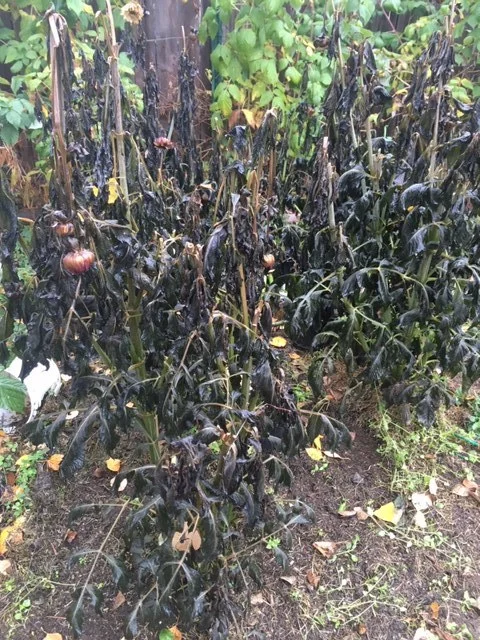
Wait until after the first hard frost to dig your tubers. You’ll know when its time when the plants look completely dead! The stems will still have some green in them but the leaves will look awful. (Quite possibly the ugliest photo I’ll post on my blog!)

Cut off the stems right above soil level and then gently pry up the tubers with a shovel or a pitchfork. The tubers are rather delicate, so pry gently! Use your hand to carefully dust off the biggest clumps of soil.
At this point, it’s important to make sure all your varieties are properly labeled. They can quickly get all scrambled up once they come out of the soil!

Use a hose to spray the tuber clump clean!
Look how many tubers I got on this baby!!! If they all save beautifully, this one plant will give me about 15-20 tubers for next year :)
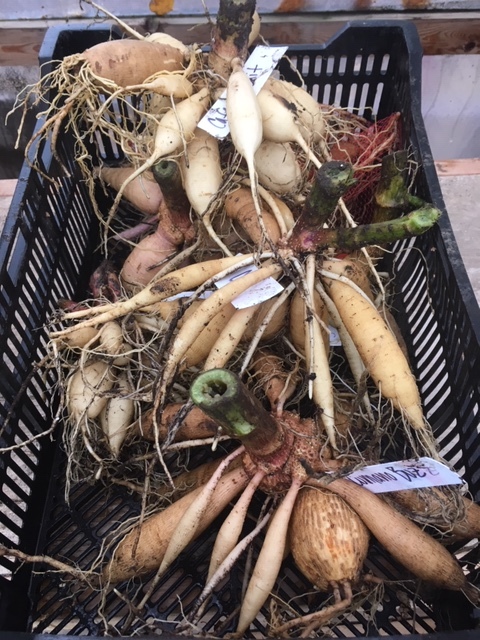
Again, make sure you label your tubers so you know what you’re getting next year.
Place them somewhere to dry for 2-3 days. Mine are in my hoophouse and in my shed, gently stacked in bulb crates or hung from the ceiling.
If drying in an outbuilding or outside, don’t let them freeze!
Be sure to also read “Dahlia Saving Part 2” to learn all about dividing, packing and storing your tubers.
Your Local Wedding Flower Primer

All local Alaskan flowers in a large, lush, cascading bouquet.
As the summer winds to a close I’m reflecting on a very fun (but hot and smoky) wedding season.
For those of you looking to get married in 2020, I want to talk you through the how-tos and what-to-expect when using our local flowers for your wedding.
Sourcing
During the blooming months of summer (May through September) I source all my flowers for weddings and events from my garden and/or from my flower farming friends in the Matanuska/Susitna Valley.
My garden (Turnstone Farm) produces blooms from tulips to dahlias and a variety of smaller blooms and foliage. In addition, I love walking my local trails and alleys looking for foraging material.
Two of my other favorite farms are Brown Dog Farm and the Persistent Farmer. The former grows a huge variety of high quality blooms and foliage. The later is an expert in growing dahlias. Both are a very far trek from my home garden and studio but worth the drive when I need additional design material.
Design
My ideal wedding customer doesn’t necessarily need to have the local vision. But she/he must want something a little wild and edgy. Not because this is what you get with local, but because this is how I like to design! As the photo above represents, I like the bride to look like she’s holding a garden in her arms.
My happiest customers want a variety of floral textures and may have a color palate but aren’t in need of specific floral varieties.
Pricing
The photos of your wedding will last a lifetime! The flowers in your photos will forever represent your amazing day. Because of this, they are worth every penny.
Local flowers are not necessarily less expensive than the local wholesaler. Why?
Farming in Alaska is more expensive than many places in the Lower 48. We have to ship supplies, seeds, equipment way farther than most farmers.
I pay fair market value to the farmers I source my flowers from.
I pay my employees a living wage.
Every penny you pay for local flowers, however, supports your local Alaskan economy! Thank you!!
How to Book a Wedding
Booking a wedding with the farm is easy! Head over to our “Flowers” page and scroll down to the “Weddings” section. There you will be prompted to fill out a quick contact form. We will get back to you ASAP so we can talk about your flower vision.
Other Things to Think About
When visioning for your special day, look at lots of online images. Hone your ideal wedding bouquet/arrangement/etc. to one final image. As you scroll through all the great pintrest photos, remember most of the images you see online don’t necessarily represent what’s in season locally. Know that we can produce a floral piece that represents your style while not always getting you every flower variety you request.
If wanting to DIY-it with our bulk flower buckets, look at photos and count the number of blooms/foliage stems in each piece. This will give you a good idea of how many buckets you need for your event.

Why Support Local Sustainable Floristry
What is the benefit of buying local, sustainably grown flowers? Keep reading to find out!
1) You support a local business! Purchasing from a local business keeps money in our community. Our business in turn supports other local businesses. So where does your dollar go when you purchase flowers from us? To local grocery stores, to employees that live in your neighborhood, to local banks, to our local garden stores and to other local farmers.
2) They’re freshest! Most flowers make a journey around the globe before landing on your dining room table. Since our flowers are cut right before you buy them, they will last longer in your vase without the need for chemical floral preservative.
3) Lower carbon footprint! Since we’re way up here in Alaska, most flowers in the grocery and at the flower wholesaler have traveled thousands of miles while being refrigerated. That’s a lot of energy just to bring you blooms! But our farm is RIGHT DOWN THE STREET! We can walk our flowers to the market!
4) No harmful chemicals! Most flowers you buy at the grocery have been pumped with floral preservative after harvest and doused with chemical herbicides and pesticides before harvest. Here at the farm we ONLY USE ORGANIC GROWING METHODS! This means we nurture our soil to avoid weed and pest problems. If we do have issues we only use products that fall under organic certification. After harvest we treat our blooms carefully by keeping them cool, giving them fresh water and selling them super fresh so we don’t need to use floral preservative.
5) Eco-friendly design! All our design is done foam free. Why does this matter? Floral foam is filled with nasty carcinogenic chemicals and never biodegrades. It simply breaks down in the landfill into micro-plastic compounds. What a disaster these are! Not to mention the chemicals released when handling this product. And since we don’t use a preservative in our flowers, after your event, you can compost them worry free!
6) This is my dream! By buying our product, you are supporting my dream of growing and designing flowers. Thanks SO MUCH!
I’d love a comment to let me know what YOUR DREAM is and how I can support you!
9 Great Shop-Local Mother's Day Gifts
Hoping to buy a mom something special, unique and LOCAL? Keep reading and I’ll highlight some ideas for gifts that I (and any other Anchorage mama) would LOVE to receive.

1) A massage from Nina or Helen at Open Space - for a mama who needs some great bodywork, Nina and Helen are experts.
2) Jewelry from Wolf + Rove - order online, it’s easy and fast. And her earrings are AMAZING!
3) Jewelry from Shovonne at Arctic Treasures - I just read about her in the Press and would love to support this local mama and Alaska Native artist.
4) Ice cream cone from Wild Scoops then a stroll on the Coastal Trail
5) Dinner at Jack Sprat- for a little more adventure, ride bikes on the Bird to Gird trail!
6) Dinner and an art film at Bear’s Tooth
7) Cinnamon rolls and coffee at Fire Island Rustic Bakeshop - it you haven’t checked out their new South Anchorage location, you must!
8) Our very own BOUQUET SUBSCRIPTION program from the farm! Buzz on over HERE to learn more.
9) A MARKET CARD from the farm so your mama can load up on her choice of flowers, herbs and greens all summer long. Did you say “Yes, please?” then learn more HERE!
Do you have more GREAT ideas? Share them below for all to read!

Planning Your Dream Garden
I know it’s the middle of winter but believe it or not, it’s time to plan your dream garden!
To be honest, here on the farm this is a HUGE undertaking. Every year it gets a bit easier but I am always surprised by the time this takes.
As a home gardener your task is a little simpler but give yourself time and have fun!
I want to break down your garden planning job into a few smaller tasks. Next to each task I will have a description on how I do this and a link to an actual PDF sample of my planning tools.
1) Make a crop list. List all the crops you are going to grow!
How do you decide? I like to grow things I like to eat! Start there then browse through your seed catalogs and find a few other things you might like to try.
How do you choose varieties? Read about each variety carefully. For Alaska, shorter days to maturity is important especially with very long season crops (like tomatoes). Also try to read between the lines. What are the descriptions NOT saying. For example, I tried a short season cucumber advertised as a great variety for northern growing. Sure win right? Not quite. The flavor and texture was almost unpalatable. Our chickens feasted on those.
I make a simple spreadsheet with the following information on it: crop (i.e. broccoli), variety (Belstar), source (where I bought my seed), days to maturity or DTM (you’ll see this in the description online or on the back of the seed packet), weeks to maturity WTM (just divide your DTM by 7 - I like to do this cause it’s way easier to count back by weeks than for days to figure out when you need to plant), notes (YOU MUST TAKE NOTES THROUGHOUT THE SEASON ON EACH CROP).
CLICK HERE to see a sample of my planing spreadsheet! I have left on a few extra columns here in case you want to add these on yours too.
2) Draw your garden. Sit down and draw your garden!
I like using grid paper for this. Then each grid increment can be a 1 foot or 6 inch increment. OR you can just draw on plain paper and just mark off your actual garden dimensions.
Pencil in where you want each of your chosen crops to grow. Remember to think about taller plants (or plants that need to be trellised) - place these on the north side of your garden so they don’t shade smaller crops. Crops that stay in the ground the whole summer (like broccoli or potatoes) can be further away from your paths than crops you might harvest more often (like salad greens).
This helps you plan where things go and how much you can fit in your area. This also becomes a record (keep your dated drawings) so you can rotate where you grow each crop in subsequent years.
3) Make a planting calendar
CLICK HERE to see a sample of my planting calendar. I plan by week. Week 1 is the first week of the year - using week numbers (and not just dates) is helpful in order to use past planting calendars to plan for future planting dates since actual dates may fall into different weeks each year.
In order to make sure I’m seeding things when I need to I usually start by planning when I want to harvest each crop.
For example, if I need all my broccoli harvested by September 1st, I’ll count back its weeks to maturity (days to maturity/7). If broccoli has 66 days to maturity (or 9.5 weeks to maturity) I will make sure my plants are planted in the ground by the end of June. Note that since broccoli is usually started indoors, I need to add additional time for germination (maybe a week) and indoor growth (a few weeks). So I would start my seeds the first week of June.
Remember you don’t want ALL your beans or broccoli or whatever to be ready at once, so stagger your plantings. Each plant is different but Johnnys and High Mowing, two of my favorite seed saving companies, are usually good at suggesting how far to stagger your plantings in order to get a steady supply of crops all summer.
CLICK HERE to read my previous blog all about ordering seeds.
A note on days to maturity (DTM): DTM is a best guess the seed company can give based on when the plant goes in the ground. Crops usually direct seeded (salad mix, peas, beans, carrots, etc) have a DTM from date sown. Crops usually transplanted (cucumbers, tomatoes, etc.) have a DTM from the time you plant them in the ground. I know this is a bit confusing so remember to use DTM as a guide but not as a written-in-stone rule.
So there you go! Now you’re ready to get started planting.

Do you need holiday gift ideas?! Here are 5 Favorite Books from my Gardening Library
Looking for that special gift for a gardening friend?! Or need an addition to YOUR gardening library? I’ve got you covered this season.
While I know it can be overwhelming to sift through ALL those gardening books (there are so many), when you come across a winner it can be SO valuable in helping your skills grow.
Here you can see a handful of my favorite books that are currently on my farm/garden library shelf.
Looking for that special gift for a gardening friend?! Or need an addition to YOUR gardening library? I’ve got you covered this season.
While I know it can be overwhelming to sift through ALL those gardening books (there are so many), when you come across a winner it can be SO valuable in helping your skills grow.
Here you can see a handful of my favorite books that are currently on my farm/garden library shelf.

1) Cool Flowers by Lisa Mason Ziegler.
Flower growers this book will blow your mind! It will debunk all sorts of conventional advice on when to plant your flowers. Use this book to grow super hearty blooms that are ready to enjoy from EARLY in the summer to LATE in the fall. A perfect how-to in a compact book. Flower gardening
2) The New Organic Grower by Eliot Coleman.
I grow organically. And as far as I’m concerned there is no other way to grow (or eat for that matter). No one needs more toxic chemicals in their lives.
At some point down the road I might move toward certifying my farm but at this point I’m too small for it to make financial sense. BUT I follow organic guidelines and Eliot is the man to learn from if you need some extra info!
In addition, he grows in a cold climate so has pertinent information on northerly food production. A CLASSIC READ THAT NEEDS TO BE PART OF EVERY GARDENERS LIBRARY. Vegetable gardening
3) Mini Farming: Self-Sufficiency on 1/4 Acre by Brett Markham.
Ok, I admit when I read titles like this I tend to roll my eyes. But my husband bought this book awhile ago and when I was hungry for something to read I picked it up and was 1) surprised how much I learned and 2) a little taken aback that I hadn’t read it sooner!
The chapter on compost alone is worth the price of the book. I’ve read a lot about compost (and honestly have struggled with implementing a good system on my farm) but for some reason this book really made composting make sense (finally!) and simple.
In addition, you will learn how to grow way more veggies on your tiny urban plot by following Brett’s guidelines. Vegetable gardening
4) Grow your own cut flowers by Sarah Raven.
Although Sarah writes from the perspective of growing in a much more temperate climate, this comprehensive book is loaded with valuable information for every flower gardener.
It is conveniently organized by flower type so is easy to reference. She also throws in some great info on cutting and arranging from your garden flowers! Flower gardening
5) The Flower Farmer: An Organic Grower’s Guide to Raising and Selling Cut Flowers by Lynn Byczynski.
Although this is meant to be a manual for commercial flower growers it is loaded with gorgeous photos and packed with GREAT information for every flower grower. In fact, the person who recommended this book to me was a home gardener!
Lynn gives the home gardener a simple plan for a personal cutting garden, covers everything you need to know to grow great flowers and has fun profiles on flower farmers from around the country. Flower gardening
Have other favorite gardening books YOU want to share?!
Leave a comment below. I love to read and am always looking for more books to add to my library.

10 Must-grows! My absolute favorite varieties from the 2018 flower cutting garden
The end of the growing season is a good time to reflect on what went well and what needs improvement for next year. There is simply nothing that compares to learning things from experience, sometimes the lessons are hard and other times they are joyous.
I’m going to focus on the latter and share with you my ABSOLUTE FAVORITES from my 2018 cutting garden. These flowers stunned me every time I entered the garden with their productivity, abundance and beauty!
The end of the growing season is a good time to reflect on what went well and what needs improvement for next year. There is simply nothing that compares to learning things from experience, sometimes the lessons are hard and other times they are joyous.
I’m going to focus on the latter and share with you my ABSOLUTE FAVORITES from my 2018 cutting garden. These flowers stunned me every time I entered the garden with their productivity, abundance and beauty!
Tickseed (Coreopsis hybrida): this lovely small and abundant flower is GREAT for cutting. It is full of small one inch blooms that will transform from tiny bud to flower in the vase for a super long lasting cut. In the garden this flower looks full and bushy and has colors ranging from white to yellow, to orange and red.
Breadseed Poppy (Papaver somniferum): a super easy to grow flower transforms from a large and delicate lavender flower with a grape colored center to HUGE poppy pods that look super cool cut in a bouquet or dried for a fun project later.

Madame Butterfly Snapdragons (Antirrhinum majus): snapdragons love growing in Alaska - they like relatively cool weather. Mine bloomed continuously from early July through the end of October!! This variety is an open faced frilly bloomed version of the standard snapdragon. I just LOVED these flowers. And they would look great as a dessert topping as snapdragon blooms are edible.
Amaranth - red spike (Amaranthus cruentus): A fun deep red/burgundy grain that looks stunning in arrangements and in the garden. Very easy to grow!
Cerinthe - kiwi blue (Cerinthe major purpurescens): This was my first season growing cerinthe! It is a great early season bloomer. Blue/green foliage with tiny blue/purple bells. So fun!
Dahlias: Linda’s Baby: a pinkish-orange specialty dahlia that is SO prolific in blooms, you will be amazed. Nice and long stemmed for cutting.
Cosmos - double click cranberry (Cosmos bipinnatus): Deep burgundy/pink double blooms that bloom mid summer till first frost. Huge plants and plentiful blooms.

Nigella - love in a mist (Nigella damascena): A fun flower that ranges from blue to white (it is so hard to find a true blue flower and here is one!). You can cut in flower stage or wait for the seed pod to emerge for a funky floral addition to your dining room bouquet.
Rudbeckia - cherokee sunset (Rudbeckia hirta): Simply big and gorgeous! Although the wait for blooms always seems long, they are well worth it. Big, showy burgundy to yellow double or single blooms that have a long vase life and long bloom time on the plant. Very hardy - these can be planted before the last frost.

Dusty miller - new look (Senecio cineraria): These will be looking great till the end of October this year! they’re an easy all season frosted leaf that looks great cut in a vase or in the garden. You can even dry them for making wreaths or dried bouquets.
If 10 varieties seems a bit daunting to you, pick 5 and add them to your garden next year!
I will advise that the garden stores might not carry these varieties, and that’s why I highly recommend starting your own seeds. Then you can grow EXACTLY what you want to grow.
Leave a comment here telling me 2 of YOUR favorite flowers to grow!

3 Easy Recipes to Dress up your Salad Greens
If you’re like me, you LOVE a salad every day all through the summer!
Now don’t even think of using that store bought dressing. Not only does it taste inferior to your homemade variety, but it can be loaded with yucky additives, fillers and undesirable oils.
Honestly, if I'm short on time I'll just have a bottle of extra virgin olive oil and Grand Reserve Balsamic on our dinner table to drizzle on top.
BUT, if I want something a little extra special I'll whisk up one of the following quick and easy recipes.
ANYONE can make these at home and they sure will dress up your greens!
If you’re like me, you LOVE a salad every day all through the summer!
Now don’t even think of using that store bought dressing. Not only does it taste inferior to your homemade variety, but it can be loaded with yucky additives, fillers and undesirable oils.
Honestly, if I'm short on time I'll just have a bottle of extra virgin olive oil and Grand Reserve Balsamic on our dinner table to drizzle on top.
BUT, if I want something a little extra special I'll whisk up one of the following quick and easy recipes.
ANYONE can make these at home and they sure will dress up your greens!
Simple Garden Salad
Carefully wash and dry:
4 generous handfuls of salad greens (use any of the following combinations: lettuce, salad mix, mustard mix, arugula, spinach)
Mix together then whisk thoroughly:
1 garlic clove
1 T vinegar (use red wine, white wine, apple cider or balsamic vinegar)
Salt to taste
Fresh ground black pepper
3-4 T olive oil
Put salad greens in a large bowl, add about three quarters of the vinaigrette, toss and taste. Add more dressing if needed.
(adapted from Alice Waters’ The Art of Simple Food)
Maple Balsamic Vinaigrette
Combine all ingredients in a sealable container, cover securely and shake until emulsified. Or whisk thoroughly in a small bowl. Taste to season. Add more salt or fresh ground pepper as needed.
1/2 C extra virgin olive oil
1/4 C balsamic vinegar (my favorite is Napa Valley Naturals Balsamic Grand Reserve)
1T maple syrup or honey
1 T Dijon mustard (to emulsify)
2 T minced herbs (choice of whatever is fresh in the garden: chives, shallot, green onion, oregano, thyme, etc)
Salt
Fresh ground pepper
Makes about 6 oz of dressing. Store unused dressing in refrigerator for future use. Bring to room temperature before using as oil will have thickened.
(adapted from Farm Fresh and Fast cookbook)
Asian Wasabi Vinaigrette
In a small bowl whisk together:
2 t wasabi powder
2 t water
(if you're not a fan of wasabi, you can omit these ingredients and just skip to the next step)
Stir the following ingredients into the wasabi mixture:
1 T minced garlic or green onions
1 1/2 T honey
1 1/2 T rice vinegar
1 T soy sauce
1/3 C orange juice
Slowly pour into the above mixture in a slow stream, whisking constantly:
1/4 toasted sesame oil
Garnish salad with:
1 T sesame seeds
Make this into a full meal by:
Tossing in other seasonal veggies (peppers, sprouts, radish, cherry tomatoes, etc) and topping your salad with grilled wild Alaskan salmon or chicken.
(adapted from Farm Fresh and Fast cookbook)
Starting Seeds with Soil Blocks
Last year I was inspired to change up my seed starting system to include soil blocking. If you’re not sure what this is, please read on! Soil blocking requires taking a wet grow medium and using a little blocking press to create perfect stand alone squares in which to sow a seed or transplant. I invested in a 3/4” blocker for germinating slow growers and tiny seeds and a 2” blocker for transplanting into or sowing larger or quick growing seeds. These are available from Johnny’s Seeds (my favorite online planting/growing store).

New Methods
A few years ago I was inspired to change up my seed starting system to include soil blocking. I now use it exclusively.
If you’re not sure what soil blocking is, I’ll walk you through the whole process! Soil blocking requires taking a wet growing medium and using a little blocking press to create perfect stand alone squares in which to sow a seed or transplant.
I invested in a 3/4” blocker for germinating slow growers and tiny seeds and a 2” blocker for transplanting into or sowing larger or quick growing seeds. These are available from Johnny’s Seeds (my favorite online planting/growing store).
After lots of experimenting with growing medium (I’ve mixed my own, I’ve purchased all sorts of seed starting mix) I’ve settled on Pro-mix MP Mycorrhizae Organik. I purchase large bales at Southside Garden Supply each spring.
If you’re interested in trying to mix your own starting mix, here’s a recipe from Lisa Mason Ziegler. She’s author of Cool Flowers (a great book about maximizing your cool shoulder seasons for planting early in the spring or late in the fall - I’m still trying to perfect this method in a snowy climate, and honestly still sort of flailing):
Recipe
16 C sifted peat or coco fiber (I used our local Fishy Peat mix available at Mill and Feed)
4 C of sifted compost (I used Susitna Organics humidified compost)
1/4 C greensand (available at Southside Garden Supply - let me put a plug in for this awesome local shop. Thanks to the marijuana industry, this place is loaded with great stuff for the urban farm or garden set-up)
1/4 rock phosphate (Mill and Feed or Southside Garden Supply)
6-7 C water
How To
Mix all ingredients well in a large tote or bin. One batch makes around 600 mini blocks.
If you’re using Pro-mix MP Mycorrhizae Organik or another pre-made mix, just mix a set amount of soil in a tub and add water until it’s a very wet mud.
Once your planting medium is all mixed grab your blocker, dip in a dish of water (aids in releasing blocks), firmly press your blocker down into soil medium a few times to really pack it in, scrape off excess, and while holding just above the bottom of your seeding tray depress the plunger until blocks release.
It takes a few tries to get the hang of it! Seeds can then be planted in the little depression left my the blocking pin.
Get creative about what you use for trays. I use regular seedling tray bottoms with no holes. I reuse these every year for 3-5 years! Folks also use lunch trays, plates, left over styrafoam trays, yogurt lids, etc.
Growing on
To water, less is more. Although you don’t want to desiccate your precious seedlings it’s easy to over water and get disastrous results (like damping off). Be sure to water from the bottom to preserve the delicate soil block structure. They wick up water like crazy.
Once the 3/4” blocks are ready to transplant, plant directly outdoors or up-pot into a 2” or 4” block. I up-block into a 2” block for most of my starts.
The larger seed blockers come with a different blocking pin that creates a square indent that perfectly fits a 3/4” block.
Now go grow some epic plants!
Grants Galore
I imagined the winter months of 2017/2018 would bring more time for leisure, running, skiing, art, movie watching and more (and in fact I am doing a TON of these things). But I find myself also completely inundated with office work: website creation, bed planning, seed sourcing, and toiling over the application for three grants. Let's hope at least one comes our way in 2018! For a low-profit business like farming, startup money can be slim and grants can be a big help in paving the way towards profitability. Although writing them feels daunting, it's one of the reasons I LOVE farming-the fact that I have to do (and be relatively proficient at) many things: growing plants, designing systems, communication, basic accounting, marketing, business planning, budgeting, etc, etc. Cheers to the new year! And another year of farming!